
Gigli Saw: Wire Saw for Bone Surgery & Craniotomy Guide
August 3, 2026 2026-08-03 9:45Gigli Saw: Wire Saw for Bone Surgery & Craniotomy Guide
 hasni
hasni 
Gigli Saw: Wire Saw for Bone Surgery & Craniotomy Guide
A Gigli saw is one of surgery’s simplest yet most enduring instruments — a flexible, twisted wire saw used to cut bone with precision and minimal trauma. Despite the rise of powered surgical saws, it remains a trusted tool in neurosurgery, orthopedics, veterinary medicine, and emergency care. This guide covers what a Gigli saw is, its history, uses, and best practices for safe handling.
What Is a Gigli Saw?
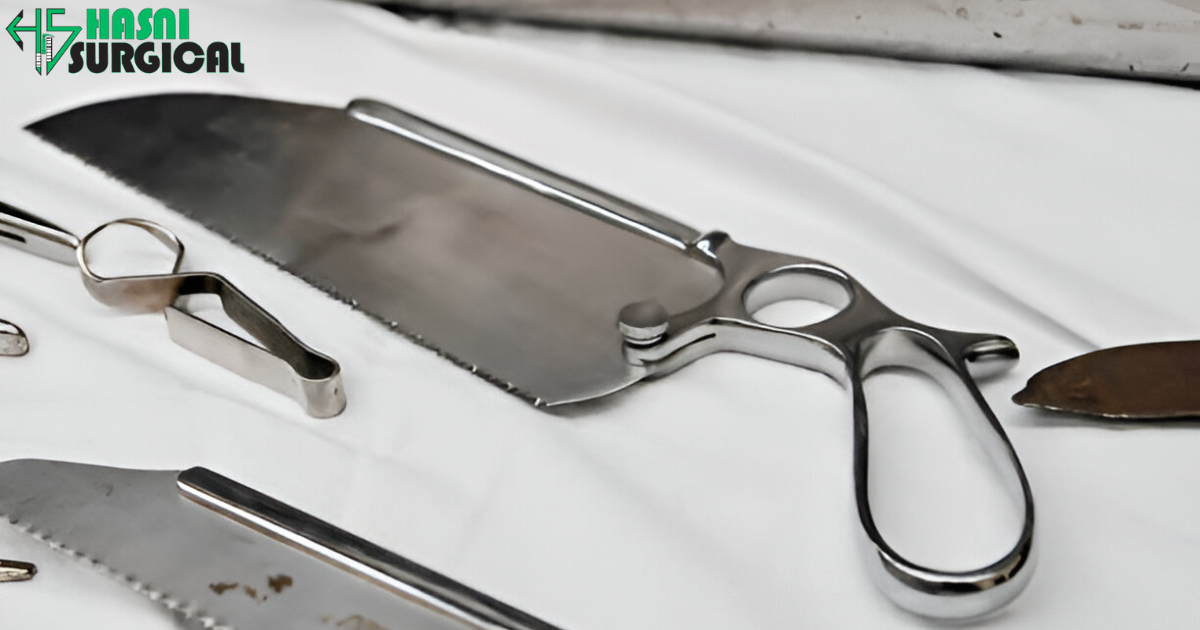
The Gigli saw consists of a fine, multi-strand twisted stainless-steel wire with finger-ring handles at each end. It is designed for controlled cutting, making it ideal for delicate operations where precision is paramount, and is available in different lengths to suit various surgical needs. Our own Bone Orthopedics Amputation Saw reflects the same commitment to precision-engineered bone-cutting tools.
Unlike a rigid blade, the twisted-wire construction of a Gigli saw allows it to flex slightly and be looped completely around a bone before cutting begins — something a straight or oscillating blade simply cannot do. This is the defining feature that has kept the instrument relevant for over a century: it can be threaded through a small space, wrapped around the target bone, and drawn back and forth by two operators (or one, using both hands) without needing the wide clearance a powered saw blade requires.
A Brief History
The Gigli saw was invented by Leonardo Gigli, an Italian obstetrician, originally to simplify a lateral pubiotomy in obstructed labour — not for bone surgery at all. Its application later expanded: surgeons discovered it could cut the skull cleanly, and it became commonly used to perform craniotomies for brain surgery, before the invention of powered skull saws. We’ve touched on this evolution before in our piece on the surgical instruments that saved the most lives throughout medical history.
What makes the Gigli saw’s history notable is how quickly it moved from a niche obstetric tool to a mainstream cutting instrument across almost every surgical specialty that deals with bone. By the early 20th century it had become a standard item in field surgery kits, valued specifically because it required no external power source — a property that remains just as relevant today in low-resource and emergency settings as it was on early battlefield surgical tables.
Design Variations and Materials
While the core concept — a twisted wire with handles — has stayed consistent, Gigli saws are manufactured in a few variations to suit different clinical needs:
- Wire gauge and strand count: Finer, more tightly twisted wires are used for delicate cranial work, while thicker, coarser wires are chosen for larger long bones or amputation procedures.
- Handle style: Simple finger-ring handles are the traditional design, while some modern variants use a T-bar or pistol-grip handle for a firmer hold during longer cutting strokes.
- Length: Shorter wires are used for confined spaces such as small joints, while longer wires are needed for wrapping around larger bones like the femur.
- Material: Surgical-grade stainless steel is standard for reusable versions, chosen for its combination of flexibility, cutting durability, and resistance to corrosion through repeated autoclave cycles.
- Disposable vs. reusable: Single-use sterile-packed Gigli wires are common in field and emergency kits, while reusable versions are more typical in hospital operating theatres with dedicated sterile processing departments.
How Surgeons Use It Today
Neurosurgery & Craniotomy
In neurosurgery, the Gigli saw is frequently used for craniotomies, where a section of the skull needs to be removed to access the brain, and its precise cutting ability is crucial for creating clean bone flaps that can be replaced after the procedure. In a craniotomy, the saw is passed from one burr-hole to another between the dura mater and the skull bone. A guide or dural elevator is typically used to protect the underlying dura while the wire is threaded through, since even a small nick to this membrane can lead to complications.
Orthopedics & Amputation
As noted in our guide to surgical instruments in prosthetic surgery and amputation, the Gigli saw is a standard choice for guillotine and emergency amputations, valued for creating a clean, level bone surface for prosthetic fitting. It pairs well with the tools discussed in our post on surgical tools for trimming and shaping bone. In these settings, the saw’s ability to work without a power source, and its low bulk compared to an oscillating saw unit, make it a practical choice when equipment or electricity is limited.

Veterinary & Field Use
The saw is also used in veterinary medicine for cutting antler, horn, tusks, and bone — a use case explored further in our article on veterinary orthopedic surgical tools. In disaster relief and remote settings, the Gigli saw becomes a critical asset where power is limited, offering a sterile, portable, and effective method for emergency amputation or bone separation — a reason organizations like Médecins Sans Frontières include it in mobile surgical kits.
Gigli Saw vs. Powered Bone Saws
| Feature | Gigli Saw | Powered Bone Saw |
|---|---|---|
| Power requirement | None — fully manual | Requires battery or mains power |
| Portability | Extremely compact, lightweight | Bulkier, needs a charged unit or power source |
| Cutting speed | Slower, operator-controlled | Faster, especially for large bones |
| Precision in confined spaces | Excellent — can be looped around the bone | Limited by blade access and clearance |
| Typical setting | Field surgery, craniotomy, amputation, low-resource settings | Hospital operating theatres with reliable power |
Best Practices for Safe Use
Proper positioning ensures the wire is looped correctly around the bone; a firm handle grip and long, consistent back-and-forth strokes without excessive force give the cleanest cuts; sterile saline irrigation reduces friction and clears bone dust; and retractors help protect surrounding tissue during the procedure. A few additional considerations that experienced surgical teams keep in mind:
- Maintain steady, even tension on both handles throughout the stroke — uneven pulling can cause the wire to bind or wander off the intended cutting line.
- Use a bone guide or protective sleeve where available, particularly in craniotomy, to keep the wire from contacting soft tissue as it is threaded through.
- Avoid excessive speed; the Gigli saw’s advantage is control, and rushing the stroke increases the risk of an uneven cut or wire fatigue.
- Irrigate continuously to reduce heat buildup from friction and to keep bone dust from obscuring the surgical field.
Common Problems and Troubleshooting
Even a well-made Gigli saw can present a few practical challenges during use:
- Wire fraying or breaking mid-procedure: Usually a sign of metal fatigue from repeated sterilization cycles or a manufacturing defect; inspect wires before use and retire any showing visible fraying.
- Binding or catching in the cut: Often caused by uneven tension between the two handles, or by attempting to force the stroke rather than allowing the wire to cut at its own pace.
- Difficulty threading the wire around the bone: Can be addressed with a purpose-made wire guide or a blunt instrument such as a dural elevator to create a path for the saw.
- Slower-than-expected cutting: May indicate a dull or worn wire that should be replaced, particularly for reusable units approaching the end of their validated lifespan.
Care and Sterilization
Like all reusable surgical instruments, a Gigli saw must be properly cleaned and sterilized between uses to prevent surgical site infections. For a full breakdown of sterilization methods and why they matter, see our guide on sterilized medical instruments and infection prevention. In practice, this means thoroughly rinsing bone debris from the twisted wire strands immediately after use, since dried tissue can lodge between the twists and is difficult to remove later, followed by standard autoclave sterilization according to the manufacturer’s validated cycle.
Regulatory Standards
Reusable Gigli saws intended for clinical use are typically manufactured to recognized quality frameworks such as ISO 13485 for medical device quality management, and carry CE marking where sold into the European market, alongside compliance with applicable national medical device regulations for the destination country. Buyers sourcing these instruments for hospital, humanitarian, or export use should confirm the manufacturer can document stainless steel grade and sterilization validation.
Why It Still Matters
Though developed more than a century ago, the Gigli saw remains relevant in modern surgery — prized for its simplicity, reliability, and flexibility across neurosurgery, orthopedics, trauma care, and emergency response. In an era of increasingly powered and electronic surgical tools, its complete independence from electricity or batteries is not a limitation but a genuine clinical advantage in field hospitals, disaster response, and any setting where equipment reliability cannot be guaranteed.
At Hasni Surgical, we manufacture precision bone-cutting instruments — including Gigli-style wire saws and amputation saws — built to the durability and accuracy surgeons depend on. Explore our orthopedic and bone surgery instruments →
Frequently Asked Questions
Q1: What is a Gigli saw used for?
A Gigli saw is a flexible, twisted-wire surgical saw used to cut bone with precision, most commonly in craniotomy, orthopedic surgery, amputation, and veterinary bone-cutting procedures.
Q2: Who invented the Gigli saw and why?
It was invented by Leonardo Gigli, an Italian obstetrician, originally to simplify a lateral pubiotomy during obstructed labour — not for bone surgery. Its use later expanded to craniotomy and orthopedic procedures.
Q3: Why is a Gigli saw still used when powered saws exist?
It requires no electricity or battery power, is extremely compact and portable, and can be looped completely around a bone in confined spaces where a rigid powered blade cannot reach — making it valuable in field surgery, disaster response, and low-resource settings.
Q4: How is a Gigli saw used in a craniotomy?
The wire is passed between two burr-holes in the skull, threaded carefully between the dura mater and the bone using a guide or dural elevator, then drawn back and forth to create a clean bone flap that can later be replaced.
Q5: Is the Gigli saw painful or traumatic compared to other bone-cutting tools?
Used correctly under anesthesia with proper technique, its thin wire and controlled cutting action typically produce a clean cut with minimal surrounding tissue trauma compared to some rigid cutting tools.
Q6: Can a Gigli saw be reused, and how is it sterilized?
Yes, reusable stainless steel Gigli saws can be cleaned and autoclaved between procedures following the manufacturer’s validated sterilization cycle, provided the wire shows no signs of fraying or damage.
Q7: What materials are Gigli saws made from?
Reusable Gigli saws are typically made from surgical-grade twisted stainless steel wire, chosen for its flexibility, cutting durability, and resistance to corrosion through repeated sterilization cycles.
Q8: Is the Gigli saw used in veterinary medicine?
Yes, it is used in veterinary settings for cutting bone, antler, horn, and tusk, particularly where a compact, non-powered cutting tool is preferable.
Q9: What causes a Gigli saw wire to fray or break during use?
Metal fatigue from repeated sterilization cycles, a manufacturing defect, or excessive force during cutting are the most common causes. Wires showing any visible fraying should be retired before use.
Q10: What should I look for when buying Gigli saws for a hospital or field kit?
Confirm the manufacturer holds ISO 13485 certification and, where relevant, CE marking, along with documented stainless steel grade and sterilization validation, and choose wire gauge and length appropriate to your typical procedures.
