
How Do Veterinary Surgical Kits Differ by Animal Type? Let’s go over 4 Important Types
August 8, 2025 2025-08-08 6:50How Do Veterinary Surgical Kits Differ by Animal Type? Let’s go over 4 Important Types
 hasni
hasni 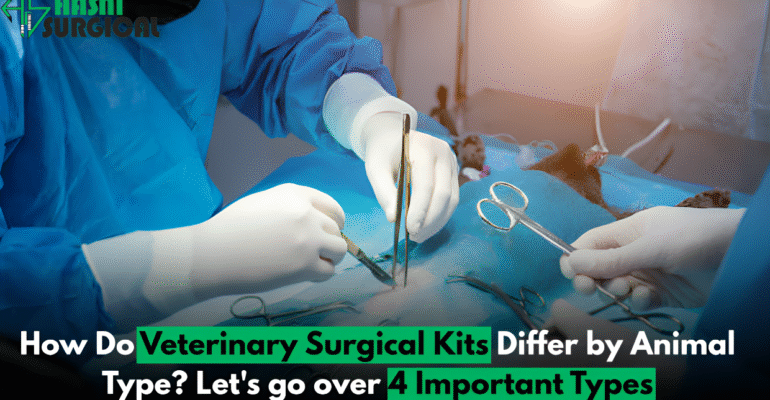
How Do Veterinary Surgical Kits Differ by Animal Type? Let’s go over 4 Important Types
Veterinary surgical kits are essential tools utilized to carry out safe and effective procedures on animals. However, not all surgical kits are created equal. What the small home cat needs is quite different from what the large farm cow or horse will require. Being aware of how surgical kits differ by animal type is important for veterinary clinics, farm veterinarians, and animal hospitals.
On this blog here, we will explain the major differences among surgical kits for dogs, cats, horses, and livestock (e.g., cows, sheep, and goats). We’ll let you know how each animal’s anatomy, common procedures, and handling issues determine the design and selection of instruments.
Why Veterinary Surgical Kits Are Species Specific:
Every animal species has its own:
- Anatomy and size
- Behavior under stress or sedation
- Common diseases and surgical needs
- Requirements for restraint and positioning
- Healing response and post-operative care
Due to these reasons, surgical kits are assembled or chosen individually according to the species and type of operation (routine vs special). Let’s break it down by animal category.
1. Canine Surgical Kits
The dog is one of the most frequently operated-on animals in veterinary medicine. From standard spaying and neutering to orthopedic procedures and soft tissue operations, dogs need a wide range of instruments.
Essential Tools in a Canine Surgical Kit
- No. 10, 11, or 15 (Scalpels and Blades)
- Straight and Curved (Mayo Scissors)
- Metzenbaum Scissors (soft tissue)
- Needle Holders (such as Olsen-Hegar or Mayo-Hegar)
- Mosquito and Kelly (Hemostats)
- Tissue Forceps (Adson, Brown-Adson)
- Retractors (such as Gelpi or Army-Navy)
- Spay Hook for ovariohysterectomies
- Suction Tips (Yankauer or Frazier for abdominal procedures)
Features that are not unique for Dogs
- Smaller instrument sizes than for cats
- Handles that are shorter for narrower chests
- Special orthopedic kits can contain bone plates, wire cutters, and pin drivers
- Application of canine dental kits for oral procedures
2. Cat Surgical Kits (Feline)
Anatomically, cats differ from dogs and need more careful handling. Their organs are smaller in size, their tissues are thinner, and they are more sensitive to stress and anesthesia.
Major Tools in a Feline Surgical Kit
- Miniature Scalpels (usually No. 15 blades)
- Fine-Tipped Tissue Forceps (such as Debakey or Adson)
- Small Curved and Straight Scissors
- Mini Mosquito Hemostats (for sensitive bleeding control)
- Miniature Needle Holders
- Mini Retractors (for delicate procedures)
- Spay Hooks (smaller than canine)
- Micro Suction Tips (in very sensitive soft tissue procedures)
Special Features for Cats
- Surgical instruments are lighter and smaller in total
- High-precision instruments are needed because of delicate tissue structure
- Dental sets are highly specialized because of thin oral cavities
- Orthopedic kits for cats employ smaller implants and micro pins
3. Equine Surgical Kits
Surgery on horses is a very different area because of the animal’s size, physiology, and complexity. Most equine surgeries are conducted either in specialized clinics or controlled field conditions.
Essential Tools in an Equine Surgical Kit
- Large-Mayo and Metzenbaum Scissors
- Equine Scalpels with Long Handles
- Large Needle Holders (such as Mayo-Hegar 8″)
- Heavy-Duty Forceps and Clamps
- Self-Retaining Retractors (such as Balfour)
- Equine OB Equipment (chains, snares, fetal extractors)
- Trocars and Cannulas (for relief of abdominal gas)
- Dental Speculums and Rasp Kits
- Hoof and Limb Surgery Instruments
- Sternal and Pelvic Retractors
Unique Features for Horses
- Instruments are larger and heavier-duty
- Often need surgical drapes and positioning equipment
- Field surgery kit design—often portable and in sterilizable cases
- Common procedures include castrations, wound repairs, orthopedic surgeries, and colic surgery
4. Livestock Surgical Kits (Cattle, Sheep, Goats)
Livestock on farms are treated in-clinic and in-field. These animals often require large-animal surgical kits that accommodate their species-specific needs, mainly calving, wound therapy, dehorning, and herniorrhaphy.
Typical Instruments in a Bovine/Caprine/Ovine Kit
- Castration Equipment (emasculators, Burdizzo)
- Obstetrical Equipment (chains, handles, hooks)
- Tail Docking and Dehorning Instruments
- Scalpels and Large Scissors
- Rumenotomy Sets (trocar, rumen magnets)
- Laparotomy Sets (for C-sections, hernia repairs)
- Sternal Retractors
- Rope or Sling Kits (restraint)
- Hoof Trimming Knives and Nippers
- Suture Kits with Heavy-Gauge Needles
Special Features for Farm Animals
- Tools are strong and usually portable
- Used often under field conditions—needs to be strong and easy to clean
- Contains equipment for reproductive procedures and emergency situations
- There may be a slight variation between ruminants (cattle, goats, sheep) and swine, who need special instruments
Comparison of Veterinary Surgical Kits: Dogs vs Cats vs Horses vs Farm Animals

🐶 Dogs
- Instrument Size: Medium
- Precision Tools: Moderate
- Portability Required: Not typically needed
- Dental Instruments: Yes—for cleaning, extractions, and oral surgeries
- Common Surgeries: Spaying, neutering, tumor removal, orthopedic repairs
- Restraint Needs: Muzzles, physical restraints, or sedation
- Sterilization Frequency: High—instruments are regularly cleaned and sterilized

🐱 Cats
- Instrument Size: Small and lightweight
- Precision Tools: High—due to delicate tissues and small anatomical structures
- Portability Required: Rarely required
- Dental Instruments: Yes—fine, narrow tools for small mouths
- Common Surgeries: Spaying, neutering, wound repairs, dental cleaning
- Restraint Needs: Sedation, gentle wraps, or towel restraint
- Sterilization Frequency: High—especially important due to high infection sensitivity

🐴 Horses
- Instrument Size: Extra-large and heavy-duty
- Precision Tools: Moderate—with emphasis on strength and reach
- Portability Required: Yes—many kits are designed for field use
- Dental Instruments: Yes—includes speculums, floats, and rasps
- Common Surgeries: Castration, colic surgery, orthopedic procedures
- Restraint Needs: Slings, stocks, sedatives
- Sterilization Frequency: High—though field use may include chemical sterilization

🐄 Farm Animals (Cattle, Sheep, Goats)
- Instrument Size: Large and robust
- Precision Tools: Low to moderate—focus on function and durability
- Portability Required: Yes—often used in barns or open field environments
- Dental Instruments: Rarely used
- Common Surgeries: Cesarean section, castration, dehorning, hernia repair
- Restraint Needs: Ropes, headgates, chutes
- Sterilization Frequency: Moderate to high—especially in sterile field surgeries
Importance of Sterilization and Quality
Sterilization and quality of instruments are important to any species. Rust-free stainless steel is best in every set of surgical instrument packs. The instruments must be:
- Autoclavable or chemically sterilizable
- Ergonomically designed for reuse
- Stored in trays or rolls to minimize contamination
Instrument sharpness, alignment, and regular checking should also be maintained by veterinarians to ensure surgical standards.
Procedure-Specific Kits
In addition to species-specific kits, procedure-specific surgical kits overlap across species. Some examples are:
- Orthopedic Kits (bone cutters, pin drivers)
- Soft Tissue Surgery Kits (laparotomy, enterotomy)
- Ophthalmic Kits (for fine surgeries in the eyes)
- Dental Kits (scalers, elevators, luxators)
- OB & Reproductive Kits (speculums, extractors)
These are usually chosen alongside the animal-specific kits for comprehensive surgical readiness.
Final Thoughts: The Right Kit Makes a Difference
Surgery in veterinary settings is not one-size-fits-all. Surgical equipment that is suitable for a Labrador retriever will never be suitable for a Holstein cow or a Siamese cat. Selecting the correct surgical kit depending on animal type, procedure, and location (clinic or field) is required to introduce successful outcomes, reduce complications, and deliver quality animal care.
You’re either a field veterinarian, vet technician, or veterinary supplier—species-specific surgical kits aren’t a luxury—they’re a must.
Hasni Surgical: Precise Instruments for Every Animal
We at Hasni Surgical manufacture and supply a complete range of veterinary surgery sets intended for dogs, cats, equines, and large animals. Be it the feline spay, a canine ortho surgery, or a large animal C-section, our sets are built with precision, durability, and safety considerations.
Looking for customized veterinary kits?
We offer OEM, branding, and custom-set configurations to match your surgical needs.
FAQs
Q1: Can I utilize the same surgical kit for dogs and cats?
Although there is some overlap, the tools used for cats need to be smaller and finer. You should have separate or double-sized kits.
Q2: What should veterinary instruments be made of?
Sound surgical-grade stainless steel (such as 304 or 420) so that they are strong and can be properly sterilized.
Q3: Are equine surgical kits portable?
Indeed, the majority of field-use kits are presented in strong, autoclavable cases that may be easily carried to barns or stables.

Comments (17)
Eva Bahringer
Wow superb blog layout How long have you been blogging for you make blogging look easy The overall look of your site is magnificent as well as the content
hasni
Thank you for your kind words.
Eric Cassin
Your blog is a treasure trove of valuable insights and thought-provoking commentary. Your dedication to your craft is evident in every word you write. Keep up the fantastic work!
hasni
Thank you. We truly wish to help educate people!
Rene Lubowitz
Your writing is a true testament to your expertise and dedication to your craft. I’m continually impressed by the depth of your knowledge and the clarity of your explanations. Keep up the phenomenal work!
Merritt Hodkiewicz
of course like your website but you have to check the spelling on several of your posts A number of them are rife with spelling issues and I in finding it very troublesome to inform the reality on the other hand I will certainly come back again
Destiny Shields
Your blog is a testament to your dedication to your craft. Your commitment to excellence is evident in every aspect of your writing. Thank you for being such a positive influence in the online community.
Cecile Sporer
Somebody essentially lend a hand to make significantly posts I might state That is the very first time I frequented your web page and up to now I surprised with the research you made to create this particular put up amazing Excellent job
Erwin Keebler
Your writing has a way of making even the most complex topics accessible and engaging. I’m constantly impressed by your ability to distill complicated concepts into easy-to-understand language.
Eloisa Wyman
I do trust all the ideas youve presented in your post They are really convincing and will definitely work Nonetheless the posts are too short for newbies May just you please lengthen them a bit from next time Thank you for the post
hasni
Thank You for your advice. We always welcome constructive criticism.
Aracely Schmeler
Your passion for your subject matter shines through in every post. It’s clear that you genuinely care about sharing knowledge and making a positive impact on your readers. Kudos to you!
Janis Leffler
Your writing is like a breath of fresh air in the often stale world of online content. Your unique perspective and engaging style set you apart from the crowd. Thank you for sharing your talents with us.
Laurine Brown
Wow amazing blog layout How long have you been blogging for you made blogging look easy The overall look of your web site is magnificent as well as the content
Danny Kertzmann
Fantastic site A lot of helpful info here Im sending it to some buddies ans additionally sharing in delicious And naturally thanks on your sweat
Matilda Spencer
I just wanted to drop by and say how much I appreciate your blog. Your writing style is both engaging and informative, making it a pleasure to read. Looking forward to your future posts!
Idell Bartell
I am not sure where youre getting your info but good topic I needs to spend some time learning much more or understanding more Thanks for magnificent info I was looking for this information for my mission