
Who Are Sialkot’s 5 Top Surgical Instruments Manufacturers? A List to Find the Best Surgical Manufacturers
July 25, 2026 2026-07-25 12:16Who Are Sialkot’s 5 Top Surgical Instruments Manufacturers? A List to Find the Best Surgical Manufacturers
 hasni
hasni 
Who Are Sialkot’s 5 Top Surgical Instruments Manufacturers? A List to Find the Best Surgical Manufacturers
Sialkot: The World’s Surgical Instruments Capital
Sialkot, Pakistan produces an estimated 70-80% of the world’s surgical instruments, a reputation built over more than a century of specialized metalworking craft. The industry traces back to the late 1800s, when local artisans began repairing and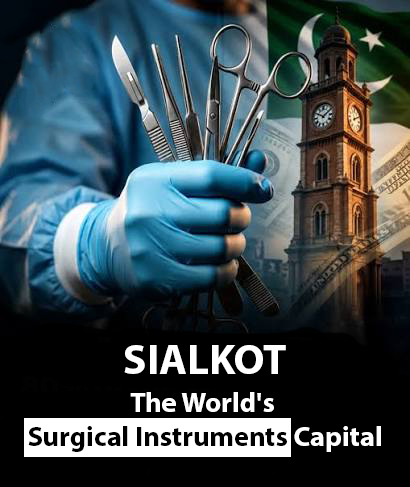 then manufacturing instruments for British colonial-era army surgeons stationed in the region. By the early 1900s, Sialkot craftsmen were producing complete instrument ranges from scratch, and word of their quality and affordability began attracting export orders from Europe and beyond.
Today the city is home to roughly 1,900 small and medium-sized surgical units employing close to 100,000 people, exporting scalpels, forceps, retractors, scissors, and complete instrument sets worth over $400 million USD annually to hospitals and distributors in more than 150 countries. You can read more about the city’s manufacturing scale, history, and export data in our guide on surgical instruments manufacturing in Sialkot.
With so many manufacturers competing on price, quality, and certification, choosing the right supplier can be genuinely difficult for hospitals, distributors, and individual buyers — especially for international buyers who cannot visit the factory floor in person before placing an order. This guide profiles five of Sialkot’s most established surgical instrument manufacturers, explains what separates a reliable exporter from a risky one, and gives a practical checklist you can use before signing a purchase order.
Why Sialkot Became the Global Hub for Surgical Instruments

A few factors, layered over decades, explain why one mid-sized Pakistani city ended up supplying most of the planet’s surgical tools:
- Generational expertise: The craft is passed down through families. Many workers spend their entire careers perfecting a single stage of production — forging, milling, grinding, or final inspection — a level of specialization that is difficult to replicate quickly elsewhere.
- Raw material access: Most established manufacturers use German-grade stainless steel (Grade 410 and 420), the same material specified by European and American instrument makers, giving Sialkot-made tools comparable corrosion resistance and durability.
- Cost structure: Lower labor costs combined with decades of manufacturing efficiency let Sialkot exporters offer significantly lower prices than Western manufacturers without necessarily compromising on material grade.
- Certification infrastructure: Testing labs, certification bodies, and the Sialkot Chamber of Commerce and Industry (SCCI) are all locally based, which shortens the path from production to an ISO- or CE-marked, export-ready product.
- Product range: Rather than specializing in one niche, most Sialkot manufacturers produce across surgical, dental, orthopedic, veterinary, ophthalmic, and beauty instrument categories, letting buyers consolidate orders with a single supplier.
Meet Sialkot’s Top 5 Surgical Instrument Manufacturers
1. Hasni Surgical
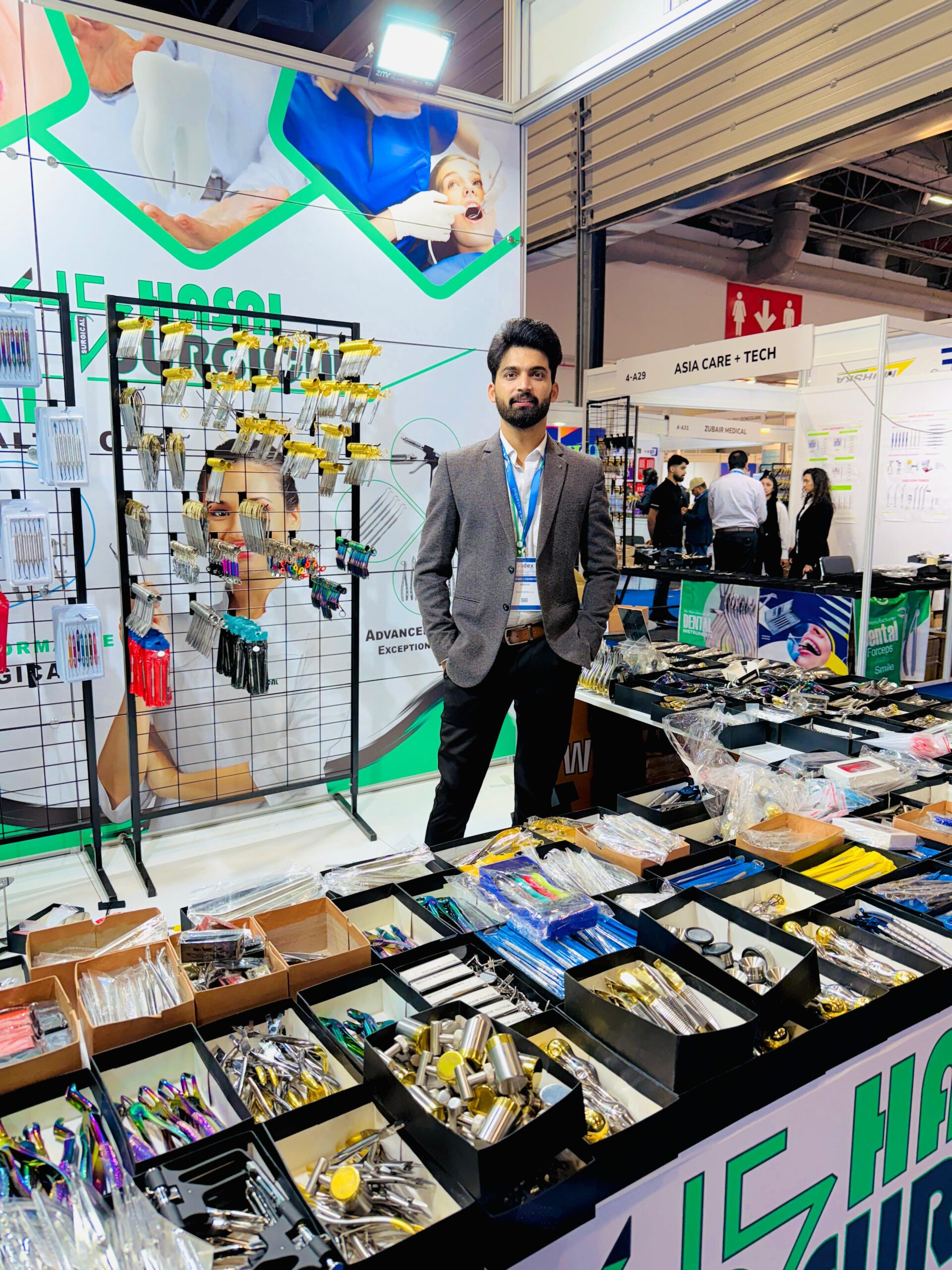
Hasni Surgical is one of the top surgical instrument manufacturers in Pakistan, known for its wide range of high-quality products. They offer diverse surgical items to B2B and B2C customers.
Established in 2017 in Sialkot, Punjab, Pakistan, Hasni Surgical specializes in crafting high-quality resistance instruments. It’s renowned globally for surgical, dental, and medical instruments, including anesthesia laryngoscopes, dental equipment, and electro-medical devices. With a dedicated team of 11–50 employees, the company uses platforms like eWorldTrade to connect with a broad customer base.
Hasni Surgical demonstrates its commitment to excellence through participation in global industry events like the IDEX Dental Expo 2026 in Istanbul, Turkey, showcasing its advanced products. With a registered office in Southall, England, the company expands strategically, serving global markets with top-tier medical instruments beyond Pakistan.
Hasni Surgical engages customers primarily through Instagram updates on new products and promotions and a newsletter featuring sales, new releases, and offers like buy one, get one free.
- Phone: +92 308 5391894
- Email: info@Hasnisurgical.com
- Website: https://hasnisurgical.com
Product coverage spans general surgery sets, ENT instruments, ophthalmic tools, orthopedic implants and instrumentation, plastic surgery instruments, and veterinary sets — all documented in detail across the company’s product guides and blog, including deep-dive articles on surgical forceps, titanium surgical scissors, and cardiovascular surgical instruments.
2. SSR Surgical Co.
SSR Surgical Co. is an established Sialkot exporter with an active presence on LinkedIn and international trade databases such as D&B, giving prospective buyers visibility into company profile, trade history, and competitor data before placing an order — useful due diligence for first-time importers who have no other way to verify a supplier’s track record.
The company is certified by the Sialkot Chamber of Commerce and holds ISO 9001, ISO 13485, ISO 17664, and ISO 11607-2 accreditation. That specific certification spread is worth noting: ISO 17664 relates to information supplied by the manufacturer for the processing of reusable medical devices, and ISO 11607-2 covers packaging systems for terminally sterilized medical devices — both signal a supplier that has invested specifically in the sterilization and packaging side of compliance, not just general quality management.
3. Jalal Surgical
Located near Sublime Chowk on Head Marala Road in Sialkot, Jalal Surgical is a privately owned manufacturer established in 1985, giving it roughly four decades of continuous operation. The company manufactures a broad catalogue spanning general surgery instruments (forceps, scissors), ENT tools, veterinary instruments including spay kits and ear-cropping clamps, and micro/neurosurgery instruments such as liposuction cannulas.
Like most established Sialkot exporters, Jalal Surgical offers both bulk and single-piece ordering, which makes it a reasonable option for buyers who want one supplier across several instrument categories rather than sourcing general surgery tools and veterinary tools separately.
4. Alispo International
Alispo International, established in 2003, has built roughly two decades of experience manufacturing dental, beauty, veterinary, orthopedic, and laparoscopic instruments. The company operates from a dedicated manufacturing facility in Sialkot and holds CE, ISO-9001-2000, ISO-13485-2003, and GMP certifications, positioning it as a compliance-focused exporter for buyers who need documented regulatory paperwork alongside the physical product — particularly relevant for hospital procurement teams that require certification copies as part of their own vendor onboarding process.
5. Acheron Instruments Pvt. Ltd
Acheron Instruments has operated in the industry for decades, with production based in Sialkot and a corporate office in Lahore. The company has expanded internationally with offices in the USA, Australia, and the UAE, and has reported high annual production volumes across general surgery, specialty, and veterinary instrument lines. Acheron positions itself around competitive pricing at scale alongside broad product customization, which tends to suit larger distributors placing recurring bulk orders rather than single-clinic buyers.
Certifications Explained: What ISO, CE, and FDA Actually Mean
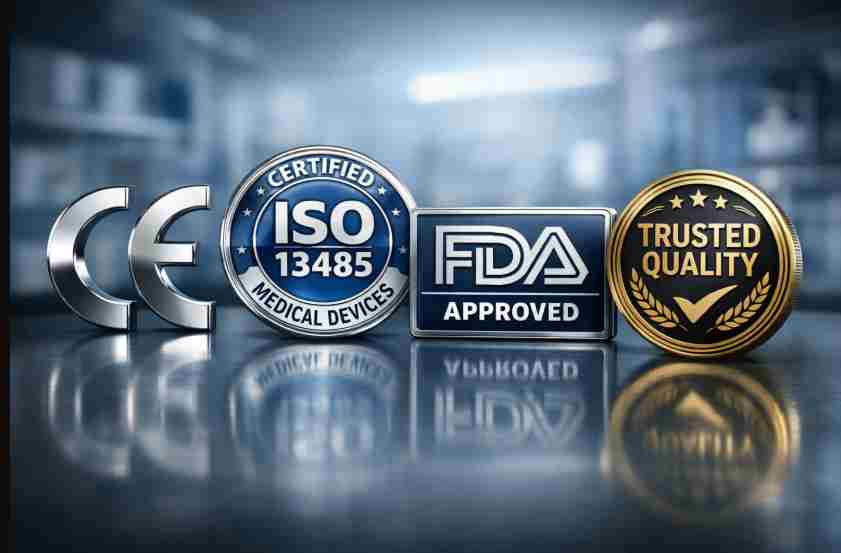
Certification names get thrown around loosely in supplier marketing, so it helps to know what each one is actually verifying before treating it as a quality guarantee:
- ISO 13485: The core international standard for a medical device quality management system. It confirms the manufacturer has documented, auditable processes covering design, production, and post-market surveillance — not that any individual instrument has been independently tested.
- CE Marking: Indicates a product meets European Union health, safety, and environmental protection requirements, allowing it to be legally sold within the European Economic Area.
- FDA Registration: For the US market, manufacturers and devices must be registered with the FDA. Registration itself is not the same as FDA “approval” for higher-risk devices — most basic surgical hand instruments fall under lower-risk classifications with lighter regulatory requirements.
- ISO 17664 & ISO 11607-2: More specialized standards covering reprocessing instructions and sterile packaging integrity respectively — worth asking about specifically if you plan to reuse and re-sterilize instruments rather than buy single-use devices.
A genuine certification should come with a certificate number you can verify with the issuing body, and a reputable manufacturer will provide this on request without hesitation.
How Sialkot Manufacturers Actually Make an Instrument
Regardless of which company a buyer chooses, the underlying manufacturing process across Sialkot’s surgical instrument industry follows a broadly similar path:
- Raw material selection: Stainless steel rods or sheets are sourced and inspected for grade and consistency before cutting.
- Forging: The steel is heated and pressed into the rough instrument shape using dies and hydraulic presses.
- Milling and grinding: The forged blank is milled and ground to precise dimensions, with cutting edges and jaw serrations shaped at this stage.
- Heat treatment: Instruments are hardened and tempered to reach the correct balance of hardness (for cutting edges) and flexibility (for spring-action instruments like forceps).
- Polishing: Each piece is hand-polished to a mirror or matte finish depending on the product specification.
- Quality inspection: Individual instruments are checked for dimensional accuracy, sharpness, jaw alignment, and surface finish.
- Sterilization and packaging: Finished instruments are cleaned, sterilized where applicable, and packed to the required export standard.
Buyers evaluating a manufacturer should ask which of these steps happen in-house versus which are outsourced, since a fully vertically integrated factory generally has tighter control over consistency than one that outsources forging or heat treatment to a third party.
Product Categories You’ll Find Across Most Sialkot Manufacturers
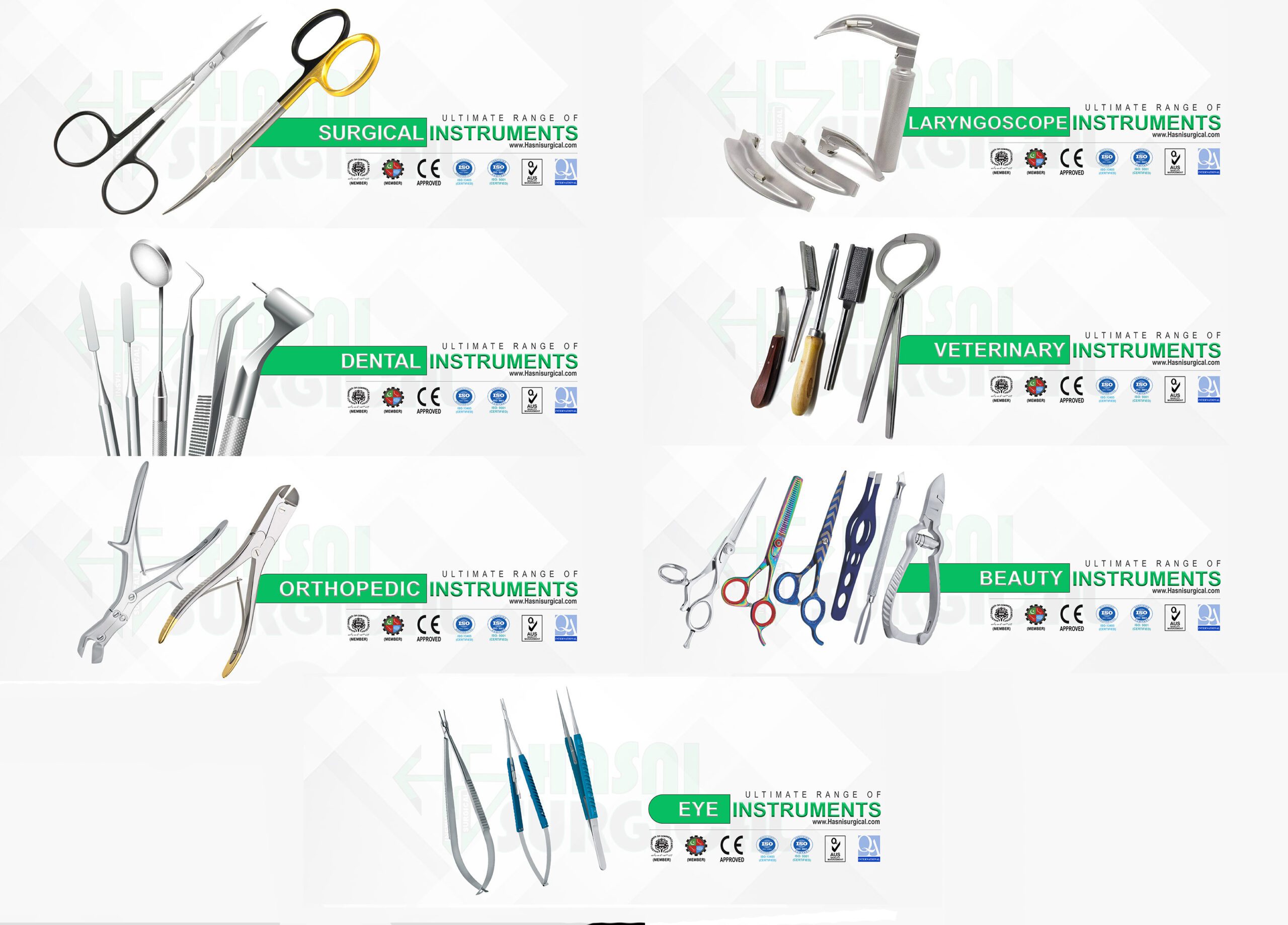
Most of the manufacturers on this list, including Hasni Surgical, cover overlapping categories rather than a single narrow niche:
- General surgery sets — scissors, forceps, hemostats, retractors, needle holders
- Orthopedic instruments — bone-holding forceps, plate benders, cannulated instrument sets, implant tools
- Dental instruments — extraction forceps, elevators, scalers
- ENT instruments — specula, curettes, forceps for ear, nose, and throat procedures
- Ophthalmic instruments — micro-scissors, forceps, and irrigation/aspiration tools for eye surgery
- Veterinary instruments — spay kits, ear-cropping clamps, and adapted general surgery tools
- Beauty and personal care — manicure/pedicure kits, barber scissors
Buying across categories from a single, well-documented supplier can simplify quality control and shipping consolidation compared with sourcing each category from a different factory.
Buyer’s Checklist: How to Choose Among Sialkot’s Manufacturers
Since so many companies operate out of Sialkot, a few practical checks help narrow the list before committing to an order:
- Certifications: Look for ISO 13485 at minimum, plus CE marking for the European market and FDA registration for the US, and ask for verifiable certificate numbers.
- Minimum order quantity: Smaller clinics and individual buyers should confirm MOQ before requesting a formal quote — many manufacturers require bulk orders only, while others, like Hasni Surgical, accept single-piece orders.
- Material transparency: Ask specifically which stainless steel grade (410, 420, or 440) is used in a given product line, since grade affects rust resistance, edge retention, and overall instrument lifespan.
- Sample availability: A manufacturer willing to send a paid sample before a bulk order is generally more confident in — and transparent about — its own quality control.
- Export track record: Ask how many countries the company currently ships to and how long they have actually been exporting, not just how long they have been manufacturing for the domestic market.
- Customization capability: If you need private labeling, custom packaging, or logo engraving, confirm this is available and get a sample of prior custom work if possible.
- Communication and lead times: A supplier that gives clear, written production and shipping timelines up front is easier to plan around than one that gives vague estimates.
Common Mistakes Buyers Make When Selecting a Supplier
A few recurring mistakes show up when buyers are sourcing from Sialkot for the first time:
- Choosing purely on price: The lowest quoted price sometimes reflects a lower steel grade or skipped inspection step rather than genuine efficiency — always compare like-for-like specifications.
- Skipping the sample order: Committing to a full bulk order without first testing a small sample batch removes the one real quality checkpoint available before a large financial commitment.
- Not verifying certifications: Certificate logos on a website are easy to display; a legitimate supplier will not hesitate to share the actual certificate number for independent verification.
- Ignoring after-sales support: Instrument rust, minor defects, or shipping damage happen occasionally even with reputable suppliers — ask about the return or replacement policy before, not after, a problem arises.
Frequently Asked Questions
Q: Why is Sialkot known as the world’s surgical instruments hub?
Generational craftsmanship, access to German-grade stainless steel, competitive labor costs, and a century of specialized supply chains have made Sialkot the source of an estimated 70-80% of the world’s surgical instruments.
Q: What certifications should I look for when buying from a Sialkot manufacturer?
At minimum, ISO 13485 for quality management. CE marking is required for sales into the EU, and FDA registration is relevant for the US market. Ask for certificate numbers you can independently verify.
Q: Can I order a small quantity from these manufacturers?
It varies by company. Hasni Surgical, for example, accepts orders starting from a single piece, while some larger exporters require bulk minimums, so it’s worth confirming MOQ early in discussions.
Q: What stainless steel grade should surgical instruments be made from?
Grade 410 and 420 stainless steel are the industry standard for reusable surgical instruments, offering a practical balance of hardness, corrosion resistance, and the ability to withstand repeated autoclave sterilization.
Q: Is it safe to order surgical instruments internationally without visiting the factory?
Many buyers do so successfully by requesting a sample order first, verifying certifications independently, and confirming a clear shipping and return policy before placing a bulk order.
Q: Do these manufacturers offer custom branding or private labeling?
Most established Sialkot exporters, including Hasni Surgical and Alispo International, offer OEM and custom-branding services for distributors and hospital groups ordering at volume.
Conclusion
Sialkot’s surgical instrument industry is large, competitive, and deeply specialized, with manufacturers ranging from century-old family businesses to modern, internationally expanded export operations. Each of the five companies profiled here has built a distinct reputation — whether through certification depth, product breadth, decades of operating history, or international office presence.
Hasni Surgical combines the region’s manufacturing heritage with flexible single-piece ordering, full OEM documentation, and a growing international presence across Doha and Sharjah alongside the core Sialkot production base. Whether you are a hospital procurement team, a distributor, or an individual clinic owner, taking the time to verify certifications, request a sample, and confirm shipping terms will make the difference between a smooth first order and a costly mistake. Contact Hasni Surgical today for a quote or to request a product catalogue.
